Showing posts with label values. Show all posts

Saturday, December 28, 2024

Collapse Protocol


         By Brandon Johnson (World: Green)


Restoration Acceleration Consortium (RAC) has activated its collapse protocol based on evidence supporting the projection of world population peaking next year, and that the population of the most powerful nation in the world, the United States, has already peaked and is dropping as would be expected due to the dominant extinction drivers. Our current projection, prepared with the assistance of Sally the AI, is that the U.S. population will reach zero by 2032, nine years before global extinction.


The collapse protocol transitions our activity to rapid application of what we have learned at the largest scale possible, which includes the rest of the world. With Sally’s help, we have integrated aspects of world Hikeyay’s global strategy into our activity profile with a focus on restoration and growth of natural habitat, despite the potential for it becoming illegal here in the U.S. The incoming administration favors the exact opposite: an extreme agenda of exploitation that will likely be a major contributor to waste generation and direct destruction of habitat that we expect to accelerate the collapse.


Among the lessons applied by the protocol is the distribution of value-based proclivities throughout our world’s population. Their increasing variability will require counter-intuitive interventions that we have already anticipated based on historical analogs but have been unable to test due to their likely negative effects under normal conditions. That testing will be a high priority as opportunities present themselves in this early phase of the collapse, especially here in the U.S, where we expect many to appear within the next year.


In the interest of security, RAC is shutting down Green Horizon Station within three weeks, including destruction of all Interlink infrastructure except, of course, the core node of the Mountain Sisterhood, which will remain active in its natural sporadic mode. Transformation of lessons learned and collected data to safe and usable forms is continuing until then along with maximum data flow to Hikeyay for use by others and, if we’re successful, any survivors from here.

Reality Check


The Timelines model’s projections for the world and United States in simulation Green are as described in the blog post. Election results and their impacts track with real events and include my own speculation about the details. The definition of “collapse” as a dropping population that is unlikely to stop, is what RAC is expected to use, while the model’s definition is the range of habitat ratio (people per unit of remaining natural habitat that humans depend upon, normalized to its maximum) from 0.5 to 1.0. 


“Values based proclivities” refers to global preferences associated with a mix of three values: people, natural habitat, and waste. Prior to collapse as defined by the model, the distribution of values across the world population (or any closed ecosystem) is constant, with sub-groups such as nations occupying ranges within it. During collapse, the distribution changes such that, in the end, the preferences for all values are the same.


The Interlink and Mountain Sisterhood, described and discussed in previous posts, are fictional means of communication between “worlds” which, of course, are simulations based on analysis of historical data. As a work of micro-fiction with a crude resemblance to a set of use cases for the Timelines model, nothing in this blog should be confused with what is in the real world.

 

Monday, April 15, 2019

End State


TIME TO STRATEGY EXECUTION: 77 DAYS

Sally’s version of a successful strategy at the end of this century has the population and ecological footprint that humanity had in the early 1950s, in a world with half the resources that existed then. The destruction of life due to our myriad assaults and the physical feedback loops they created has been stopped with the aid of the species we spared and helped grow to sustainable levels. People’s experience with each other and the rest of nature is similar to what it was in the early 1990s, spread between the growth and peak stages with nowhere safe to go next.

Despite these superficial similarities with our past, the world looks much different from anything most people then or today would recognize. Technological progress has shifted from taking and transforming more resources to increasing and nurturing what remains. People live in what Sally calls “cached habitats,” prefabricated homes and infrastructure that supports their needs and are available for anyone’s use as long as they commit to maintenance, sharing with others, and avoiding negative impacts on all surrounding life. Everything built is designed to be reusable and biodegradable within no more than two decades, which allows for changes in local conditions and requirements for ecosystem health to influence both its decommissioning and reconstruction as needed.

Even more important than the sharing and design of places and things in service of healthy and diverse life supporting systems is the sharing and joint development of knowledge, understanding, and values that enables it. Common acceptance of basic facts, concepts, and values is absolutely critical to long-term survival, and is never allowed to be compromised; although new opinions and approaches are welcome as potential modifications and subject to rigorous test by those affected as a condition of adoption. In addition, forms and content of communication will be different, having adapted to changing survival requirements resulting from variable environmental conditions, forced mobility, and intensity of interaction between people.

What happens between now and then will determine the details of this scenario at the scale of people’s daily lives. The means and success of stopping and then reversing the degradation of planetary life support are expected to have the greatest impact, especially in setting the ratio of people to ecological resources, which affects the size and behavior distribution of the population.

“That last part is particularly problematic,” Maura said as we shared our reactions to Sally’s presentation. “She’s got some good reasons for holding onto that lower population figure, and I’ve got some of my own.”

“I was actually surprised that the number was so high, after she listed all the climate feedbacks already in progress, not to mention the accelerating extinction rates at the bottom of the food chain.” I had been reading a lot. “What are your reasons for believing it’s so high?”

“I’ve seen some ‘projections’ that indicate up to three billion of us could cease to be people, but they won’t cease to exist.”

“What the heck does that mean?” I asked, but she refused to answer.

Reality Check


Sally’s description is my own, based my latest simulations and some educated guesswork.


Friday, April 5, 2019

Dream Job


TIME TO STRATEGY EXECUTION: 87 DAYS

Lazlo set aside today for a briefing by Sally to all of STRIDE on the status and content of the current version of the global strategy. Following are some highlights.

“There are three types of problems we must solve simultaneously within the next twenty years: cultural, ecological, and physical. The cultural problems involve just humans, and relate to values, population, and consumption. Ecological problems center on the ability of other species to survive and thrive in healthy ecosystems that maintain conditions of global habitability subject to physical constraints, whose variability represents the third type of problem. The order of presentation for these problem types is the same as the order of difficulty in solving them, with the amount of difficulty increasing by about an order of magnitude for each.

“Every problem type has its own section in the strategy, with another section devoted to the relationships between each of them. Another section provides an integrated timeline of actions, events, and expected status for each system and capability of interest, which can be updated dynamically based on observations during execution. The final section is a combination summary and operator manual that enables all users to determine appropriate action at least eighty percent of the time based on their local conditions. Separately provided is educational material that includes baseline knowledge and concepts for all users.

“The amount of completion for each section ranges from eleven to eighty-six percent. Cumulatively, the strategy is sixty-three percent complete with eighty-two percent confidence in quality. Reconstruction of lost databases using cached data that was not on the sabotaged servers is now at fifty-six percent, which has forced creation of an annex to the strategy that provides for collection and analysis of needed data on a real-time basis from now through the end of the execution timeline. Projections of success that include estimated uncertainty currently range from twenty-one to fifty-eight percent.”

Sally displayed several graphs during the presentation, along with status summaries from each group within STRIDE. From what I understood, they all supported her story, mostly adding detail to each identified problem and what could or might be done about it.

“What did you think?” Riddick asked me as we sat in her office after the presentation. She looked the same way I felt: tired, overwhelmed, and somewhat depressed.

“If there wasn’t so much at stake, I’d start looking for another planet to live on. This place is too far gone.”

“Starting fresh,” she said, staring at the ceiling. “That’s not a new thought. It’s also a very reasonable one. Unfortunately, there are a lot of people here who wouldn’t get to go.” She closed her eyes and yet they kept moving.

“Do you mind if I ask you a personal question?” I asked tentatively.

“Sure,” she said without moving.

“What’s the deal with what you’re doing now? Forgive me if this sounds crude, but it looks like you’re watching a movie inside your head.”

She smiled and opened her eyes. “No apology necessary. I love honest questions.”

“So?”

She leaned over and stared at me. “What does this feel like?”

All I could see was her eyes, and a swirl of peaceful thoughts began replacing the ones that threatened to destroy my sanity. I struggled to summarize what was emerging, and couldn’t help but smile back. “It’s almost as if I’m in a different world.”

“When you see me like that, I am in a different world.”

She sounded crazy, but in a good way. “It must be nice,” was all I could say.

“Would you like to talk about your future now?” she asked, sitting back and breaking the mood.

“Sure.” I assumed she was talking about the fact that my mission here was done.

She pressed a button on her computer and familiar face appeared on the screen. “What do you think, Sally?”

For a second it looked like they were the same person, and then the differences returned. “Will is a great friend.” She turned to me. “You are a great friend. We wouldn’t be here without you.” I sensed a “but” coming. “I think… we need someone looking over our shoulders, asking the odd questions, questioning assumptions we didn’t know we were making.”

“You’re pretty good at that, yourself,” I told her, recalling her personal survival strategy.

“I agree,” Riddick said, and grasped my hand. “Call me Maura from now on, after you write about this.” She paused and said to Sally, “I’ll recommend to Samantha that we keep the current arrangement after his testimony.”

“In case I screw up,” I said reflexively, but Maura took no offense.

Reality Check


Numbers listed are all fictional, including the estimates of required effort for the problem types which are ballpark at best.

Sally’s version of Will’s job description matches what I would write for my dream job, for which I am available. 

To be continued on Tuesday…

Tuesday, February 12, 2019

Strategy Update Stresses Common Understanding


TIME TO GLOBAL STRATEGY DEADLINE: 17 DAYS

In a statement today, WICO Secretary General Decatur made official what Sally told me yesterday about the progress of strategy integration. He added that WICO’s Education group is preparing a means for people understand and implement the strategy that will be based on a set of simple concepts and rules which can be memorized and shared orally if necessary. 

“It is critical that we all have the same values and understanding of what is necessary and expected to serve those values,” he said. “Although there are billions of us, we have an obligation to each other that must be as strong as what our ancestors had with members of their small tribes of hunter-gatherers, and with the same ultimate goal: to ensure the survival of the group.”

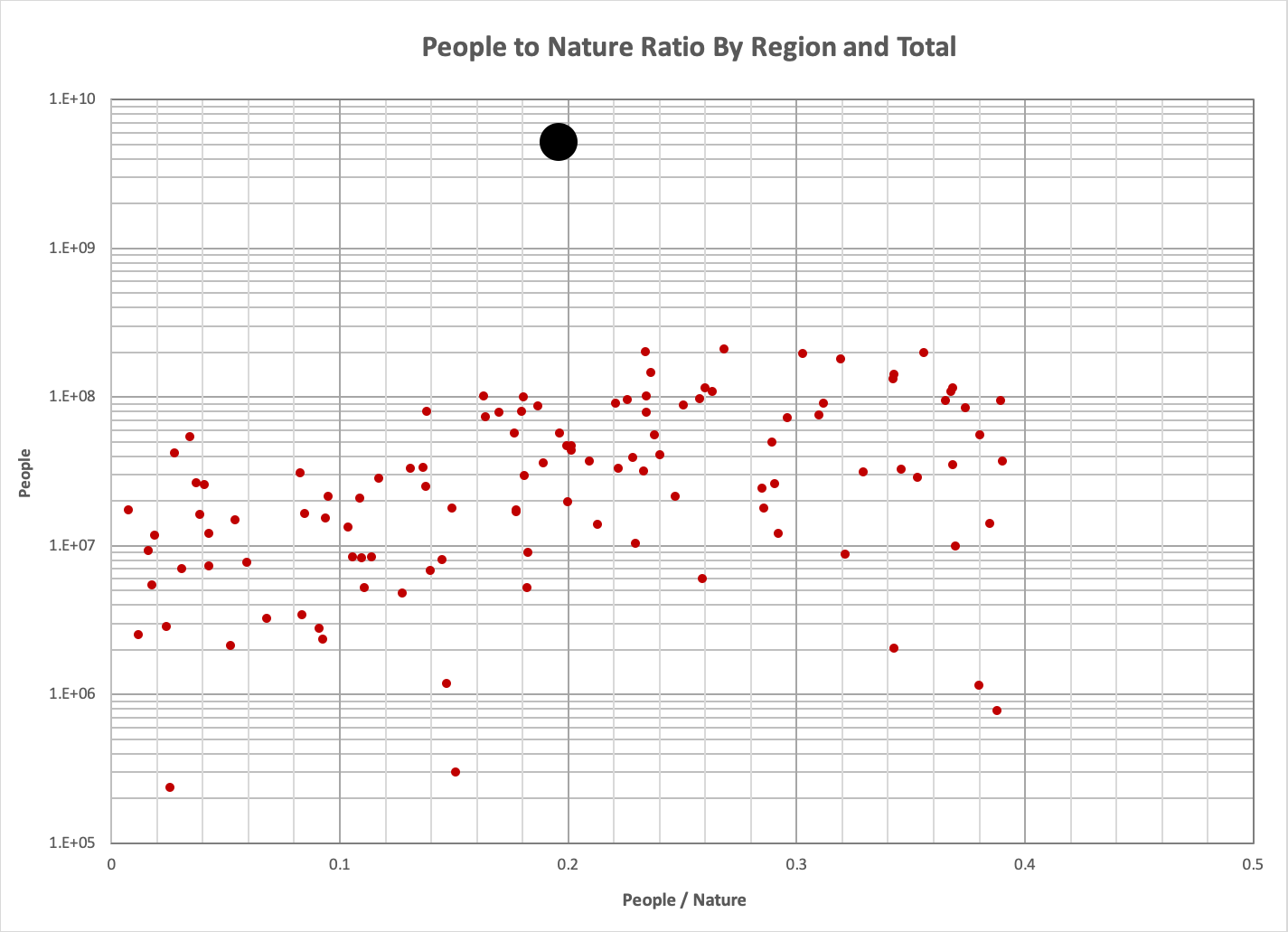
Finally, he shared a sample of a graph of populations of regions and their ratios of people to equivalent populations of other species. Such graphs can be used to relocate people and change consumption patterns in order to minimize the extinction risk. This case shows how the target population might be distributed among regions.


People/Nature ratios and populations of regions (red) and the world (black).

Reality Check


The graph is a random sample of possible “regions” based on the final state global population/nature ratio and population with an arbitrary number of regions for the purpose of demonstration only. It does not represent the result of any geographic derivation.