Showing posts with label nature. Show all posts

Friday, June 21, 2019

Historical Context


This morning, Maura tried out a lecture to a group of other professors (and me). It was a summary of the imminent extinction threat and the first public presentation of her preliminary framework for putting it in historical context. Following are some of the highlights.

“The last quarter of the thirteenth century is known for at least two technological innovations: eyeglasses and firearms. One allowed people to see better, and the other allowed them to kill more efficiently. Unknown until recently, it also marked the beginning of an era when the world’s human population would be dependent on the populations of the world’s other species. 

“Technological innovation progressed in tandem with scientific discovery, enabling advances in transportation, mining, agriculture, and construction that accelerated the conversion of everything into ‘resources’ that could be traded between people to increase how long they lived, how satisfied they were with their lives, and how many children they had.

“A second milestone was achieved in the 1930s. If we measure the amount of resources as the impact of actions on ecosystems, the resources consumed by the entire population was double what people needed to survive. After that, there would be more resources in stuff than in people. That new reality accompanied and was enabled by the creation of a global civilization marked by revolutions in science and technology, development of cheap fossil fuel, and conflict between groups of people who were trying to dominate or survive the merging of cultures into an interdependent whole.

“Rapidly accelerating per-capita consumption in the 1940s stopped growing in the 1970s, just as total consumption exceeded the amount of resources provided on a renewable basis by other species. This third milestone corresponded to a peak in life satisfaction that was achieved by four out of five people while the rest kept trying to reach that peak. Meanwhile, there was growing concern that fossil fuel production had itself reached a peak, and the status quo might not be able to be maintained.

“For more than two decades, population growth drove growth in how much of the world’s ecological resources humanity used, both in needs and wants. Science and technology contributed to more efficient use of resources that helped reduce per-capita consumption. At the end of that period, a fourth milestone was reached: the population consisted of people still pushing toward that happiness peak and people between that peak and a higher one that also corresponded to a peak in life expectancy.

“Per-capita consumption began to grow again in the mid-2000s, and most of what was added made parts of the world uninhabitable by other species and us. By 2015, more than one-seventh of the original resources were not consumable. Also, that year, a few percent of the population was not having children, reflected by a life expectancy of zero, and self-sustained impacts began cutting into the remaining resources.

“WICO projects that, if the global strategy isn’t implemented on schedule, a fifth milestone will be reached in 2023 as the world’s population reaches its peak. That will be followed by rapid population loss until 2030. Hopefully, we will settle into something between the third and fourth milestones, maintaining a smaller population by living mostly off of renewable resources produced by a healthier biosphere.” 

Reality Check


Historical events are correlated with the historical record until 1940. After 1940, projected global values for the simulation “Hikeayay” are used to identify the boundaries of the phases, which correlate to the “milestones” recited by Maura.


Thursday, June 20, 2019

Programs


During the six days since WICO Secretary General Decatur asserted that the technology already exists to stop self-sustaining impacts, the press has been interviewing everyone they can to determine if it’s true. Maura was approached a dozen times for the source of “pretty good authority that he lied,” and each time she responded that the source insists on remaining anonymous.

The Sacramento Watcher has compiled the most complete list of impacts and related technologies that I know of, and reported that at least six unspecified new technologies are being developed that are classified top secret because of their potential to be used as weapons. I suspect - but can’t confirm - that most of the new technologies fall under the category of globaforming, and would be applied to the most difficult task of refreezing permafrost that threatens to release catastrophic amounts of methane and ancient diseases into the biosphere if it melts much more.

Possibilities from Responsibilities is in the news today, advertising guided nature walks in urban areas “to introduce more people to the wellbeing they can create during the transition.” The organization is providing transportation for those who don’t have it, and providing resources for adding greenery to areas with very little or none. The programs were about to be launched when I resigned, and it’s good to see them now underway.

Reality Check


“Globaforming” is a made-up word, meaning “surgical terraforming.”


Wednesday, May 1, 2019

Personal Day


TIME TO STRATEGY EXECUTION: 61 DAYS

I took a personal day yesterday, and unfortunately could not escape either the news or my obsession with helping people know what they need in order to create their own future in line with what’s survivable.

As anyone who hasn’t had their head stuck in their work already knows, Reverend Lanton has followed through on his vow to wage war against those he perceives as trying to “prevent the apocalypse.” Members of his church and likeminded groups are actively interfering with preparations to execute on WICO’s global strategy to fight the imminent extinction threat, targeting governments, NGOs, private companies such as those involved in the Evolution over Devolution collaboration, and of course WICO itself. So far, WICO’s main offices had been targeted with protests blocking access to buildings, but last night Lanton warned at a rally that field offices and test communities were next.

Not coincidentally, Lanton spoke just after President Larson unveiled a major part of the U.S. plan to help stop climate feedbacks: devoting much more resources to supporting the pollution-eating microbe development being done jointly by WICO’s Widely Dispersed Pollutants group and the Department of Defense. She further revealed that it is being merged with the isolation and neutralization technology behind the biosafing solution that I worked with on Monday.

While doing some much needed housework and planning how I might move to the Q.A. facility if my job with WICO is safe (which was my original purpose for coming home), I thought about how to measure the population-nature ratio on my own. From what I understood, there were three main components to the concept: people, places (environments), and things (creations by people), the relative amounts of which influence how people feel, procreate, and live longer. The experience of my house was an example of this, especially when frustration mounted in the presence of clutter and trash. One of the main objectives of the global strategy is effectively to reduce clutter in the “home” shared by people and other creatures, enabling us all to meet our needs with limited stress - but just enough to avoid eating too much, or being eaten ourselves. Becoming more conscious of stress and what (and who) was around at the time seemed like a good way to start exploring both the effects and their causes, as opposed to finding ways like entertainment to just blunt the effects.  

Maura called early this morning to warn me off from coming to work. There were two reasons: the upgraded PEAK prototype wasn’t ready yet; and affiliates of the Savior of the Apocalypse church had effectively blockaded both WICO’s Boulder field office and the Extinction Response Unit’s field office in Denver.

Reality Check


Yesterday I followed my own obsession, working to integrate what I know about ecosystems with the Timelines simulation. An interesting result, potentially useful to the simulated world and Will in particular, was quantification of a population density interpretation of the (normalized) people-nature ratio and its correlation with related global variables. 

A simple equation summarizes the distribution of resources (Population + Nature + Wants + Waste = Total Resources), where the unit of resources is what an average person absolutely needs to survive in a totally natural environment (Population = Needs), Nature = (0.88 / Sr) * Population, Total Resources is 1900 resources per square mile (land ecosystems), and Sr is the normalized population-nature ratio. This is shown below for several values of per-capita consumption (C).


Tuesday, April 23, 2019

Observations


TIME TO STRATEGY EXECUTION: 69 DAYS

Maura and I spent several hours at test community TC-013 today.  Located on one of Colorado’s mountains, this former commune has thirty full-time residents who live off the land, perform scientific investigations, and maintain a suite of environmental monitoring instruments whose data are transmitted via satellite to Boulder for analysis. Officially we were there to brief the residents about the field test development effort and recruit them to help verify the resulting approaches. Unofficially we were hoping to get some ideas of our own.

One of the oldest residents, Dr. Lei Kaleo, gave us a guided tour of the local flora and fauna with a focus on their adaptation to local soil and climate and the changes that have occurred in the thirty-three years since she moved there from Hawaii. “We’ve been lucky not to have any bad fires here,” she told us, “but it is getting warm and dry enough now to significantly stress the trees and the animals that depend on them. It doesn’t take a lot of technology to see that we’re in the middle of a crisis.”

“Do you still keep your observer log, Lei?” Maura asked.

“I’m up to volume twenty now,” Kaleo answered. “I still have my records from when you visited your cousin as a little sprout.” She took us to her tiny cabin and found a leather-bound notebook in a chest under her bed. “There’s a copy of this in a museum somewhere,” she added. “Writing things down is still the best way to track what’s happening, along with good drawings.” To prove it, she showed us multiple sketches done in pen or pencil.

“What about memory?” I asked, thinking about the most basic way to keep information, and remembering stories about so-called primitive cultures that kept extensive oral histories.

“I wouldn’t expect it to be very useful after thirty or forty years. That’s from my own experience, mind you,” she admitted.

“What was that about?” Maura asked me later as we drove to Colorado Springs to have dinner with her family. “Things won’t get so bad that oral history will be necessary.”

“Just wondering,” I replied as a new and even more radical idea began to take form.

Reality Check


Written log books are still being used by engineers (I kept several of them during my career until I transitioned into full-time writing, documenting information others didn’t want to lose). Recording technology is beginning to take their place, however.

Kaleo’s observations haven’t been verified in the real world, though they do generally match with what I’ve learned about the area.

Wednesday, April 10, 2019

Region 35


TIME TO STRATEGY EXECUTION: 82 DAYS

Sally warned me that statistically half of Region 35 was effectively dead, with three in four people living in what WICO classified as a state of collapse and the rest pushing for more growth that could eventually drive everyone into collapse. What I found when I visited there was an urban area that was indeed half-dead, if you counted infrastructure that had no resemblance to natural habitat (where anyone or any animal could survive using what was there) as “dead.”

There were plenty of stores around that imported food and other supplies from outside; and I could see how, on average and with a lot of imagination, they might be considered “habitable.” The areas where the wealthy lived had more green spaces, populated by trees and animals that seemed to be more visitors than residents. A few parks added to the appearance of natural habitat around the region, but they were by definition designed more for visitors only, with attempted residence by any creatures strongly discouraged.

This was where the core group of saboteurs had lived and worked while they hatched their plan to keep the world from inverting the ratio of artificial to natural habitat. They thrived in this environment, or thought they did, depending as they did on imported resources whose ultimate origins were no longer visceral enough to comprehend or respect.

I realized that the global strategy was as much about re-establishing that direct connection with the sources of life as it was about preserving the life itself. Here there was no urgency to achieve that goal, and I could imagine how even starting down that path might be perceived as scary, or even repugnant. Sally’s insistence on viewing each region as a spectrum of conditions reminded me that there were pockets of people who felt differently, especially among those who visited more directly habitable areas, but there were also people who were literally dying and failing to be born because the connection to their nature was effectively severed.

Reality Check


This is largely based on a simulation of a global region, intentionally vague in terms of location in order to focus on the characteristics of interest. General observations are based on my extensive experience in urban environments, mostly through my thirties.

Tuesday, April 9, 2019

Peak Sabotage


TIME TO STRATEGY EXECUTION: 83 DAYS

Mark Linster was one of nearly ten million people residing in what WICO identifies as Region 35, part of the urban corridor from Washington, D.C. to New York City. By day he worked as an information technology engineer for one of the nation’s ten largest defense companies, helping to maintain security for its world-wide computer network. At night he pursued his interest in future technologies, especially the further development of artificial intelligence.

In July of last year, Linster learned that the most advanced AI, Sanda, was near the end of its test phase, and was about to be used to analyze several years of data collected by WICO about the world’s ecosystems and physical processes. One goal of the analysis had already leaked to the press: performing a detailed threat assessment of ecosystem degradation and climate destabilization as a follow-up to the global scientific community’s warnings of growing extinction rates that could soon extend to humanity. This prompted Linster and a group of former coworkers and classmates to begin a discussion of its potential impacts on their professional and personal lives.

Six of the twenty-two group members were in biotechnology, and saw their industry as the savior of the species. Another ten had aerospace background that they felt was the key to the future through exploration and colonization of other planets. The remaining six, Linster among them, were putting their hopes in the development of virtual reality that could enable human consciousness to be embedded in machines and potentially live forever. None of the options they considered was viable without technological development; so, when they considered possible worst-case scenarios, the back-to-nature approaches promoted by many environmentalists were easily among them.

The Global Emergency declaration confirmed their greatest fears. To Linster and the others it was an abomination that one of the world’s most sophisticated technologies was being used to sell the idea of scaling down civilization’s ecological footprint to fight the threat of imminent global extinction. They viewed the preferred strategy as a betrayal of a future where people could reach their full potential as masters of their lives and potentially the Universe. In a choice between life and death, WICO was advocating that humanity become more vulnerable, not less, to forces it had spent tens of thousands of years gaining dominance over.

Linster watched in horror as political leaders signed onto WICO’s approach and developed national strategies that mirrored its guiding principle. In an unfortunately recorded conference call with everyone in the group on January 16, he advocated activating a plan he had been secretly enabling since August. They agreed, and six days later he and fourteen hackers used Sanda’s first connection to the global data network to test infiltration and espionage software that would ultimately be used to take down the information infrastructure supporting WICO’s strategy development.

“It was the hardest thing I’ve ever done,” Linster said during his testimony yesterday, “working to take down one of the greatest creations in order to save future ones. But it was the right thing to do.” He pointed his finger at the panel of six judges sitting above the witness chair in the well of the Tribunal Chamber. “YOU are the criminals here! We weren’t trying to kill everyone. We were savinga future worth having!”

Today Linster and the original group, the hackers, and their financial backers were all convicted of attempted omnicide and sentenced to ten years of pollution cleanup.

The summary above is in the public record. For my part, I gave brief testimony on Saturday, which involved verifying what I’ve reported in public, and then spent most of the weekend observing the trial and talking with various people about what happened. There was something about the motivation that didn’t seem complete, so I asked Maura if I could take some time to investigate. 

“What did Sally say about the location clue?” she asked when I suggested it might have something to do with where he lived, given what Sally sent me right before the servers crashed.

“She told me that people just passing the life expectancy peak would be aware of the risks of conditions getting worse, but be hopeful that they could find another path to improvement since they hadn’t yet seen a precipitous drop in happiness or life expectancy. The range of wealth in that region with the projections she had available at the time indicated that there was still access to the necessary capabilities. Then she admitted something rather remarkable. She said that it was her best guess.”

“Really,” Maura said after a pause that revealed her surprise.

“That makes it worth checking out by itself. Don’t you think?” I waited, and then added, “There’s also this: one of the investigators testified that included in the offsite cached data was a list of regions with their population to nature ratios. That narrowed the search considerably.”

“What about the others that were close?” she said.

“Exactly. I’d say there’s at least a security reason for looking at those too.” 

Reality Check


Sally’s “guess” is my guess. The projected number of people within half a percent of a 53% normalized population to nature ratio is about 100 million. I don't know how many of them are in the DC - NYC corridor.

Wednesday, February 13, 2019

Rule of the Thumb


TIME TO GLOBAL STRATEGY DEADLINE: 16 DAYS

I asked Sally to give me an example of the simple concepts and rules that WICO Secretary General Decatur mentioned during yesterday’s press conference.

“They’re more like rules of thumb,” she corrected. “One of the most basic ones can be easily remembered using a real thumb: There should be four times as much nature as people. Think of one of your hands as the environment. Your thumb is the people, and your fingers are plants and other animals. A hand is not a complete hand unless they’re all there.”

“What about the palm?” I asked.

“The palm is the raw resources converted by plants into resources, including other plants, that animals can use. Animals can of course use other animals as resources. The analogy breaks down there. Though if you think of fingers supporting other fingers and the thumb, then you can also remember that the thumb gets sicker as three of the fingers are removed, and dies if the remaining finger is removed.”

She explained that the “fingers” are like an economic supply chain, with each one adding value that the next one can consume. The problem facing the world is that the “thumb” not only consumes what the “index finger” produces, but also consumes what the others produce and the “fingers” themselves.

I knew there was more to it, but grasped her point that the top priority was that the basic rule needed to be remembered.

Reality Check


The rule is based on observations of how global variables change with the people/nature ratio as reproduced in the simulation. The analogy is very imperfect from an ecological perspective, but again the point is to communicate the rule.

Tuesday, February 12, 2019

Strategy Update Stresses Common Understanding


TIME TO GLOBAL STRATEGY DEADLINE: 17 DAYS

In a statement today, WICO Secretary General Decatur made official what Sally told me yesterday about the progress of strategy integration. He added that WICO’s Education group is preparing a means for people understand and implement the strategy that will be based on a set of simple concepts and rules which can be memorized and shared orally if necessary. 

“It is critical that we all have the same values and understanding of what is necessary and expected to serve those values,” he said. “Although there are billions of us, we have an obligation to each other that must be as strong as what our ancestors had with members of their small tribes of hunter-gatherers, and with the same ultimate goal: to ensure the survival of the group.”

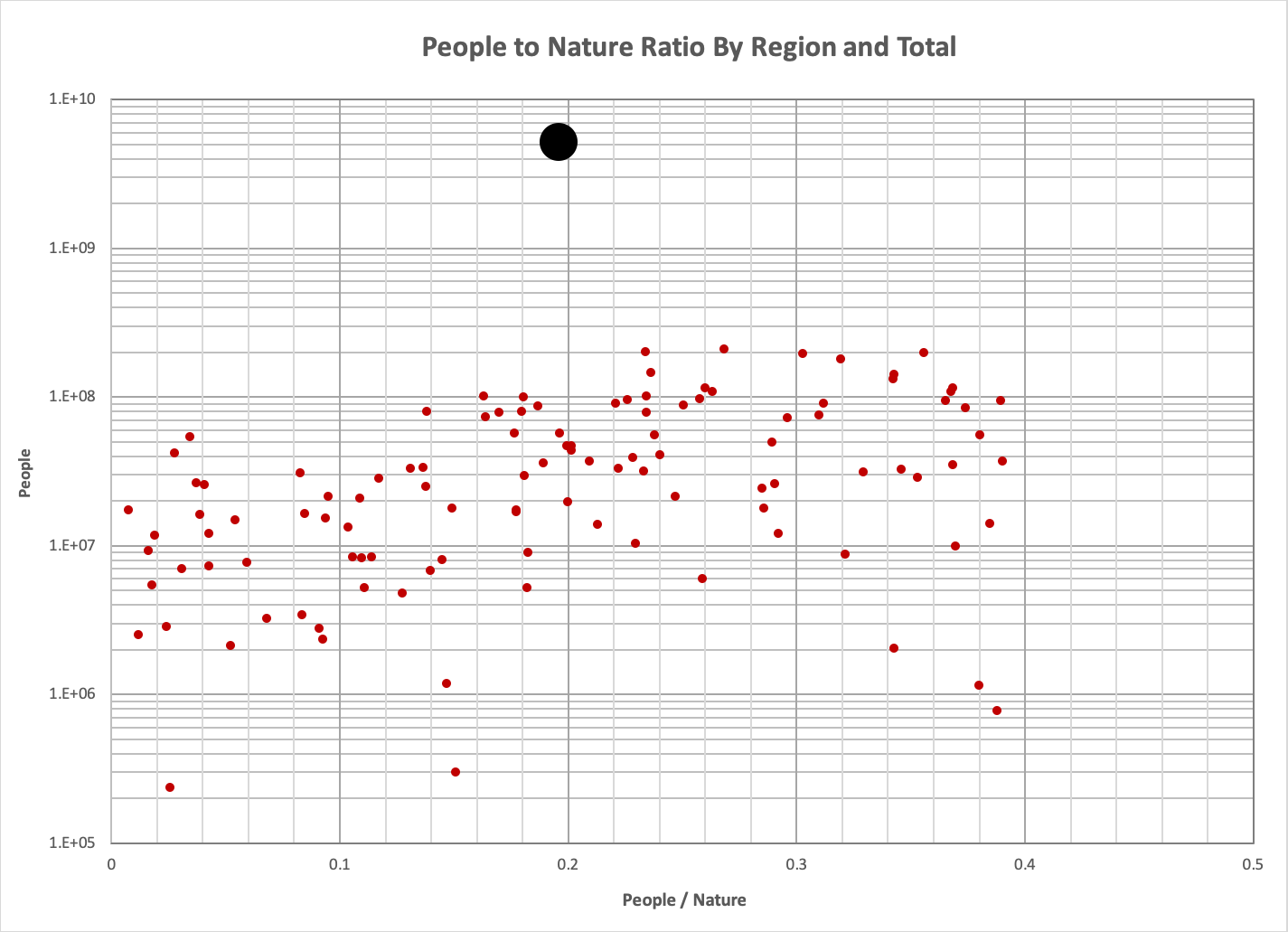
Finally, he shared a sample of a graph of populations of regions and their ratios of people to equivalent populations of other species. Such graphs can be used to relocate people and change consumption patterns in order to minimize the extinction risk. This case shows how the target population might be distributed among regions.


People/Nature ratios and populations of regions (red) and the world (black).

Reality Check


The graph is a random sample of possible “regions” based on the final state global population/nature ratio and population with an arbitrary number of regions for the purpose of demonstration only. It does not represent the result of any geographic derivation.