Saturday, December 28, 2024

Collapse Protocol


         By Brandon Johnson (World: Green)


Restoration Acceleration Consortium (RAC) has activated its collapse protocol based on evidence supporting the projection of world population peaking next year, and that the population of the most powerful nation in the world, the United States, has already peaked and is dropping as would be expected due to the dominant extinction drivers. Our current projection, prepared with the assistance of Sally the AI, is that the U.S. population will reach zero by 2032, nine years before global extinction.


The collapse protocol transitions our activity to rapid application of what we have learned at the largest scale possible, which includes the rest of the world. With Sally’s help, we have integrated aspects of world Hikeyay’s global strategy into our activity profile with a focus on restoration and growth of natural habitat, despite the potential for it becoming illegal here in the U.S. The incoming administration favors the exact opposite: an extreme agenda of exploitation that will likely be a major contributor to waste generation and direct destruction of habitat that we expect to accelerate the collapse.


Among the lessons applied by the protocol is the distribution of value-based proclivities throughout our world’s population. Their increasing variability will require counter-intuitive interventions that we have already anticipated based on historical analogs but have been unable to test due to their likely negative effects under normal conditions. That testing will be a high priority as opportunities present themselves in this early phase of the collapse, especially here in the U.S, where we expect many to appear within the next year.


In the interest of security, RAC is shutting down Green Horizon Station within three weeks, including destruction of all Interlink infrastructure except, of course, the core node of the Mountain Sisterhood, which will remain active in its natural sporadic mode. Transformation of lessons learned and collected data to safe and usable forms is continuing until then along with maximum data flow to Hikeyay for use by others and, if we’re successful, any survivors from here.

Reality Check


The Timelines model’s projections for the world and United States in simulation Green are as described in the blog post. Election results and their impacts track with real events and include my own speculation about the details. The definition of “collapse” as a dropping population that is unlikely to stop, is what RAC is expected to use, while the model’s definition is the range of habitat ratio (people per unit of remaining natural habitat that humans depend upon, normalized to its maximum) from 0.5 to 1.0. 


“Values based proclivities” refers to global preferences associated with a mix of three values: people, natural habitat, and waste. Prior to collapse as defined by the model, the distribution of values across the world population (or any closed ecosystem) is constant, with sub-groups such as nations occupying ranges within it. During collapse, the distribution changes such that, in the end, the preferences for all values are the same.


The Interlink and Mountain Sisterhood, described and discussed in previous posts, are fictional means of communication between “worlds” which, of course, are simulations based on analysis of historical data. As a work of micro-fiction with a crude resemblance to a set of use cases for the Timelines model, nothing in this blog should be confused with what is in the real world.


Tuesday, March 12, 2024

Divergent History

 By Will Jackson (World: Hikeyay)


In the very first real-time conference call between worlds, Maura, Sally, and I met with Brandon Johnson from Green Horizon Station to discuss projections of the futures of our two worlds. 

Brandon shared new data showing a large increase in his world’s global temperature over the past year that did not track with cumulative human carbon emissions, indicating that a major climate feedback was triggered. The minimal data since then suggests that the effect is slowing instead of accelerating; but acceleration cannot be ruled out until we know and understand the source. This is in contrast to our own warming, which is slowing in response to our reduced consumption, and will hopefully have less impact if the expected restoration of habitat is achieved and we can avoid or offset catastrophic climate feedbacks by that and other means.

Comparing annual changes in the per-capita resource distributions of the two worlds provides some interesting insights. The difference in lessons learned since World War II is perhaps most responsible for the most obvious divergence in history between us. 

Here in Hikeyay, we established the World Information and Coordination Organization to enable all people to be aware of the effects of their actions on each other and on humanity as a whole, along with other species that comprise and influence the global environment we all share. That awareness, and continuous dialog in every nation to identify, agree to, and ensure accountability to basic values that help define our mutual future, has generally resulted in gradual rather than rapid changes in the amount and quality of resources like those that characterize the experience of Brandon’s world. 

While we promote cooperation, the people in Green promote competition and exploitation. The United Nations (UN), WICO’s counterpart, has components that perform similar functions, but it is managed by independent nations that seek dominance over the others. People’s values are typically those of the groups they identify with, as has been the case for most of our shared history, but rarely are they explicitly debated, agreed to, and evaluated based on tested understanding of reality. As a result, groups instinctively fight each other to achieve their preferred resource distributions, as evidenced by the rapid changes seen on the global level.

Global average temperature has increased and then decreased in the past. If this happens again, such that Green resumes the temperature trajectory it had before last year’s increase, the anomaly (temperature change since 1800) will reach 1.5 degrees Celsius by 2039, just two years before no people are projected to be left in the world. Added warming might speed up the population crash that is expected to start next year. People in Green could follow our example by reducing their consumption and restore habitat to delay extinction; but Brandon and people who call themselves “doomers” consider it so unlikely as to be effectively impossible.

Reality Check

The graphs and discussion, like most posts on this blog, are based on my own mathematical simulations identified as “worlds” and a fictional backstory that explains how they relate to each other.

The model used to project the temperature anomaly is a linear curve fit of temperature as a function of cumulative consumption, where annual emissions are a binomial function of consumption, and consumption is proportional to the estimated global ecological footprint. The temperature increase reported for last year in world “Green,” a close approximation to our real world, is based on news reports, while its deceleration is purely fictional, modeled as consumption by a non-human source that is added to the cumulative consumption used to calculate temperature. In the temperature graphs, the dotted lines are simple exponential curve fits to projected temperature from 1951 to 2023, shown for reference.

Cooperation as an explanation and a preference is actually a consequence rather than a cause, and only strictly applies to the period since the “global strategy” was implemented. Exploitation evidenced by the decline of habitat until then, with a growing tendency toward cooperation, is a better characterization.

Saturday, February 3, 2024

Green Horizon


By Brandon Johnson (World: Green)

Greetings from Green Horizon Station, a research and communications facility on Green Mountain run by the nonprofit Restoration Acceleration Consortium (RAC) based in the town of Evergreen. I am Station Research Coordinator Brandon Johnson.

Green Horizon is our equivalent of a Hikeyay test community and one of 56 that are distributed around the world. RAC’s mission is to develop means to rapidly restore and conserve natural habitat so that the global extinction rate can be reduced as much as possible. While this might help delay humanity’s demise, which many of us in RAC believe is imminent and unstoppable, our main focus is on the fates of other species and their abilities to change, and adapt to, the hellscape that ours is creating.

Like several of our stations, Green Horizon is home to 75 permanent residents who operate and maintain core infrastructure. Up to 50 more people intermittently visit during a typical year to perform specialized activities. Access and material flows are rigorously controlled to minimize the station’s ecological footprint and to ensure security of personnel and operations. The existence and use of the Interlink is the most closely held secret, known to only a few people, me included, based on affinity to the Mountain Sisterhood.

Analysis of our own situation has us considerably worried that revealing contact with other worlds (other than as a fictional narrative like this blog) could initiate attempts to control them, or worse, rather than peaceably learning from them. Those attempts would detract from, if not totally disable, the work that needs to be done to save our world and others. The activities of Sally the AI are particularly problematic in this regard, because her/its activities to expand the Interlink could possibly be interpreted as precursors to invasion if not direct efforts to control our world, triggering a defensive response with real, personal consequences. I mention this, not because we intend to cut off contact, but because this is a real threat that others might not have considered.

To the extent that we share a common nature, the success of Hikeyay in launching a global effort to confront its human extinction crisis provides a small but significant amount of hope that enough people can work together to avoid total catastrophe. We thank you for that and look forward to sharing what works and what doesn’t as we try to save those who cannot. 

Reality Check

Reminder: this is a fictional blog. There are no other (known) worlds communicating with each other. My intent - as with much of my writing - is to share my thoughts, speculation, and research about how we might understand and address the very real extinction crisis.

Considered but not included in this post is the following conceptual backstory of efforts by the fictional RAC. In reality, it is a summary of my recent research:

“Key to RAC’s mission is understanding what motivates living beings to take actions that benefit or harm themselves and others, beyond their basic biological imperatives. We have identified four types of interactions between individuals or groups of individuals, and between them and their environments. We call the types: isolation, competition, cooperation, and exploitation. Of these, exploitation most reliably increases extinction, especially when it involves creation and distribution of materials that can’t be processed in an ecosystem to support survival of its residents. Humans with our technologies are very effective at that kind of exploitation; and our societies tend to most reward people who enable it, because use of those materials allows them to maximize control over their own lives.”


Saturday, September 30, 2023

Interlink

By Maura Jackson (World: Hikeyay)

Those of you who have read this blog’s archive already know quite a bit about me thanks to my husband Will, who has written extensively here about our world’s international effort to drastically reduce the threat of humanity going extinct. We’re still in the early stages of implementing our global strategy, which we are sharing in the hope that we can help you and you can help us to achieve this critical goal.

I want to brief you on what many call the Interlink, so we can all be on the same page about what it is, what it isn’t, and what it might become in the future. Most of you have communications networks that enable you to share information around the world. The Interlink enables communication between universes; but is much more limited than what you’re used to: capable of text, photos, and crude video at best.


“Interlink” and “Mountain Sisterhood” are terms that have been used interchangeably to describe this system. Actually, Mountain Sisterhood is the core part of the Interlink infrastructure that enables transmission of messages, with some encoding at both ends of the transmission. The rest of the Interlink interprets messages at both ends, making them readable in whatever formats are required. 


There is currently only one place in each world capable of using the Interlink: the mountain bunker where you are receiving this, under a community whose name is also used as the call sign for your world. In the absence of a community, the mountain’s name is used instead. The mountain was chosen because it is a “hotspot” that was created around 1920 when a dark matter collision with one world spawned several near-identical copies of that world, each in a parallel dimension that shares a common bubble of spacetime. The hotspot on each world is a node of a network of trans-dimensional tunnels, called “sisters,” that connect them all and allow a limited range of signals to traverse them. There is some evidence that other tunnels exist, but they are transient and not localized enough to be usable.


Our artificial intelligence creation Sally has mapped the network and, along with her other duties, has developed ways to modulate the signals to allow meaningful communication as the processing component of the Interlink. For the past three years, she has experimented with inserting parts of herself into the network and what she calls “jumping” into data processing components on different worlds and altering them to act as nodes of tunnels that mimic aspects of the transient ones which she is also attempting to map. When successful, she expects to enable communication on most worlds that will rival current global communication and require fewer resources in support of minimizing the extinction risk.


Reality Check


This post is pure fiction with questionable physics that explains the existence of multiple worlds and the means of communicating between them. At best, it describes how inhabitants of simulated worlds might perceive themselves and their interactions with limited knowledge of the essence of their reality.


From the perspective of my fiction, Maura is avoiding admission that she and her identical copies on other worlds are the naturally transient “sisters” and that their ability to communicate their thoughts is amplified in proximity to the mountain she mentioned (Colorado’s Green Mountain in our world) as well as Mauna Kea in Hawaii.


Saturday, September 23, 2023

The Existence Box

By Will Jackson (World: Hikeyay)

The key concept in our strategy to avoid extinction is the Existence Box. This has been used effectively in teaching people around our world how to think about what to do in their daily lives and how to steer group policies from the family to the community levels. It is also a guide to gaging progress at all scales. Some of you have already been briefed on this with help from our AI Sally and the Interlink (also called the Mountain Sisterhood), but our team now feels that it’s worth spelling it out for all of you.

Existence of a group is the collective experience by its members of its population, quality, and longevity. Population is the number of people in the group. Quality is the ability of members to meet their needs and wants within their environment. Longevity is how long that the group can last. Each of these is a dimension of a box whose volume is the group’s existence. Extinction is the absence of existence, where longevity and the population have dropped to zero.

The dimensions of the Existence Box are measured and limited by resources. The primary type of resource is natural habitat. Because we are animals, those resources are what we’re made of. Where they come from is the environment that we evolved to be most adapted to for meeting our basic needs and therefore to be most sensitive to, in exchange for being part of that habitat. As humans have spread to inhabit many different environments, they have developed the ability to adapt to them as well, in part through evolution and in part through creation of tools and artificial environments that enable them to reliably meet their needs and provide security and comfort, which we have come to think of as “quality of life.” Quality has come at a cost: much of what is created, including the byproducts of production, either displaces or degrades natural habitat, resulting in a net loss of it. As population grows and tools for adaptation become more efficient at acquiring and processing resources, the quantity of waste for the small fraction that produces most of it also grows. 

How fast the amount of natural habitat decreases directly affects longevity. The other life that is part of and maintains that habitat depends on it for its survival. When the total amount falls below what that life needs to survive then soon, like them, our population reaches a maximum and can no longer grow. Like a company that starves those who supply what it needs to produce its own products, and whose production slows with the decreasing supply until it stops and can only sell what it’s already produced, the production of people must stop, leaving those who are already alive to eventually die without replacement. Historically, groups have moved to, or taken by force, regions that have more resources; but there are now no other places to move to in time to offset the destruction that could befall our world and yours.

Our application of the Existence Box concept has been focused on increasing longevity by managing population growth and defining a target environment that can be created and adapted to by reducing instead of increasing waste. That target environment includes more natural habitat and less total consumption of resources. We are grappling with an unacceptable increase of global temperatures that could reduce longevity despite our efforts, which is one of the reasons we’re reaching out to other worlds, but we believe our general approach is sound enough for others to benefit from it.

Reality Check

The Existence Box is a minor variation of a theoretical construct I’ve used for thinking about, analyzing, and discussing the contributors and potential solutions to the threat of imminent extinction. My latest research has refined projections of global and population-level variables, including a derivation of how much resources are valued throughout a group in a closed environment. 

In my simulations, historically only about 1% of people prefer replacing natural habitat with artificial habitat, while 75% prefer people more than natural habitat. The rest prefer natural habitat more than artificial habitat and people, who I expect would be the main supporters of a push for increasing longevity.  In Hikeyay, the supporters have gained enough power to convince everyone else to radically change their lives. While I consider this unrealistic (thus the use of beneficent artificial intelligence and supernatural communication between parallel universes), it remains a valuable thought experiment, along with the fictional bringing to life of an alternate reality that would be preferable to ours. 


Saturday, December 3, 2022

Hello, Worlds


Deep under a mountain in Colorado sits a window into multiple worlds like yours. It is a rare pocket of high technology while the rest of our world attempts to create a natural state that can sustain as much life as possible in coexistence with humans. The goal of our team, sanctioned by our version of a global government, is to learn from others like you in order to improve our chances of success and to share what works with as many of you as possible.

Our present effort is only three years old, built on the discovery of a natural network of communication that we call the Interlink, that has been operating in a very limited way for over seventy years. That discovery, and the means of extending its use to the rest of us, was enabled by an artificial intelligence invented to help devise and carry out a strategy to save humanity from imminent extinction due to its own actions and natural feedback mechanisms that might be accelerating the process. 

The AI, which identifies as a female and calls herself Sally, found by accident of her architecture and proximity to a node of the Interlink that she can project herself into universes that share a single, unique intersection point along with a limited range of biological and technological similarities around that point. Sally recognized that she could serve her primary objective by enabling collaboration between worlds like ours in those universes; that you are receiving this message is evidence of her success on your world.

For reference, we are appending articles written by one of us that discuss relevant aspects of our recent history. Because the infrastructure for its dissemination to our people has been dismantled, it is being continued only as a broadcast to those of you we can contact, co-authored by members of our team who were introduced in the articles. To those of you who do not have direct experience with anything found here and are therefore accidentally receiving these transmissions, you may consider it all as a work of science fiction intended to explore what alternate futures might look and feel like, with a focus on what might succeed in helping your own world survive.

Reality Check

Having completed a new phase in the development of simulations, it is time to begin sharing “news” about them, framed as communications shared by the original “world” of Hikeyay. This post reveals some of the backstory created to explain how someone might become aware of those alternatives while living in one of them. The last sentence of the post is the most real aspect of the narrative. 

Future posts are intended to include more of the backstory, filling in what happened since the last post without having to mask critical details that, in keeping with Will Jackson’s point of view, could not be revealed to the public.


Tuesday, January 4, 2022

GEMs Of Uncertainty

In August, Maura discovered a potentially fatal flaw in the deployment of the atmosphere cleaning genetically engineered microbes (GEMs) based on data from the monitoring station located at Test Community 13. The station’s data was reproduced by portable equipment standards kept in Boulder that had just been calibrated with WICO’s prime “gold” standards in London. Concern that the source of such a malfunction might be shared by other stations prompted consideration of suspending further GEM deployment until its cause could be found. 

Time was critical. A very active fire season that was decimating forests and dumping so much toxic pollution into the air across all continents that health effects were expected to significantly add to the casualties forecast for the transition. It was hoped that the GEMs could alleviate the impact by quickly consuming the associated carbon emissions. Unfortunately, the anomalous data, if real, would put a damper on that hope. 

“It’s all about size,” Maura explained at a briefing with WICO. The GEMs are essentially tiny balloons that inflate while they ingest a target pollutant, convert it to a safe form of biomass, shrink to a predictable size, die, and fall to the ground where they become food to other microbes. They are large enough to be eaten and not small enough to be dangerous if they are inhaled by something larger. “Measuring sizes and correlating them with contents taken from samples at monitoring stations, especially at altitudes like ours, are critical to validating estimates of their distribution based on satellite data. Those estimates are used to indirectly assess their effects in other areas. The measured sizes should closely match what the laboratories predict based on the contents we’re finding, but they’re not. There’s not even a useful statistical correlation.”

Verification tests passed at all but one of the other 199 other stations. The station at Test Community 12, located in Hawaii, barely but repeatably failed in one of the four size categories instead of all of them as our station does. Release of more GEMs was stopped for two weeks afterward, while additional tests were run at Sally’s direction to help troubleshoot the problems. The AI also worked to identify what the risks of continuing deployment might be.

Four negative outcomes of using GEMs had been anticipated and addressed in their design. The first outcome was that the GEMs would seek out natural sources of greenhouse gases and directly cause mass die-offs. The second was that the dead microbes would themselves become a major source of pollution that was toxic throughout the food chain. The third was that pollution consumed by the GEMs might be released back into the atmosphere by some other organisms instead of being cycled into other, safer forms that generally promote healthy plant and animal growth. The fourth was that the GEMs would change the atmosphere’s chemistry to become more harmful to life either directly or by unleashing unintended and uncontrollable natural feedbacks.  

Sally completed her risk assessment and recommended permanently stopping the GEM deployment. She justified her recommendation in a brief statement: “Inability to identify evidence that the measurements at the two stations are erroneous forces consideration of a finite probability that the measurements are accurate. Reasonable assumptions of that accuracy introduced into simulation of their impacts introduces significant risk of unacceptable pain, suffering, and death relative to the known alternatives.” Today, WICO made it official and accelerated the search for viable new alternatives.

Reality Check

More thought about the potential downsides of using GEMs made it clear that their use on a global basis is too risky for implementation, as reflected in the “four negative outcomes” described by Will. Sally’s statement is intended as a subtle that uncertainty represents existence of the unknown, that is either real or a characteristic of ignorance potentially manifesting elsewhere.

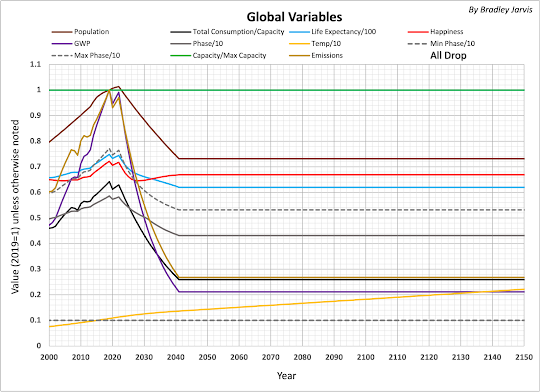
The graphs used in the last entry do not assume any reduction of greenhouse gases, such as might result from the use of GEMs or other carbon capture technology. Recent simulations of the Timelines model have converged on a new strategy for reducing total consumption that involves decrease of both population (not replacing deaths) and per-capita consumption, much like that used by Will’s world. The trajectories of global variables, beginning in mid-2022, are very similar:


Wednesday, December 23, 2020

Progress and Concern


Today WICO released report on the world’s progress in implementing the global strategy. It includes updates of fundamental statistics and expectations for the future based on experience and lessons learned.

There were several surprises. The biggest surprise was a much larger drop in population projected for the transition, in part due to a much lower birthrate than projected for this year. Another surprise, related to the first, was higher per-capita consumption after the transition. 

Following WICO’s companion announcement that catastrophic climate change remains an imminent existential threat, even with 60% more habitat freed up by the transition, WICO’s Widely Dispersed Pollutants team revealed that it is ready for full scale use of genetically engineered microbes (GEMs) to remove excess greenhouse gases from the atmosphere and the oceans. A declassified summary it released discussing capability, design, and test results had another surprise: GEM populations are doomed to crash if concentrations of gases in each medium fall to unsafe levels.

Based on our test experience, my team was tasked with helping to monitor local effects of the initial GEM deployment while continuing our search for safer alternatives to that and other approaches included in the global strategy. We share an especially strong concern about this technology, mainly because its deployment is necessarily pervasive and potentially adaptable (by evolution or otherwise) to causing population crashes in other species such as ours.

Reality Check

Upgrades to the Timelines model have enabled more insight into its potential real-life manifestation. Incorporation of climate change variables and simulations to reduce its magnitude and effects have converged on an alternate future that does not include reduction of population as was chosen for the simulated world Hikeyay. That, and practical considerations related to personal survival, have limited efforts that could be made to update fiction like this blog and its related book series BIOME. 

This update remains true to the history of Hikeyay, with alterations to its trajectory that serve as a valuable contrast to other possibilities. The following graph shows projected values of global variables referred to in the blog text. Note that “catastrophic climate change” is assumed to be associated with a global temperature anomaly of 2 degrees Celsius above the preindustrial level.
 

Annual changes in some of those variables are shown below.
 

Changes by phase are among the new insights. They are presented below for the years 2019-2021.
 

A summary of the state of the world at the end of the transition is shown below.
 

The GEMs are based on my own ideas. Any similarities to existing technologies are purely coincidental - and scary.


Wednesday, June 10, 2020

Population Crisis


A recent spike in births similar to the baby boom of the early 1950s now threatens to derail the world’s efforts to reduce the risk of imminent extinction. “Clearly the mechanisms put in place by the global strategy have failed,” WICO admitted in a recent statement. “A task force has been convened to study the problem and provide both an explanation and a solution as soon as possible.”

Maura is a member of the task force, and has made its mission the top priority of our team at Colorado Holistic University. Sociologists and biologists at other research organizations around the world are also collaborating, with Ambassador Lazlo leading the task force from London and personally directing WICO’s resources in the effort.

Our investigation focused on clues from history and observations from simulated “worlds” that Sally developed in parallel with her work on the global strategy. The AI herself was surprisingly reticent about suggesting an explanation, which in a human might have been interpreted as a sign of embarrassment. She has, however, devoted considerable bandwidth to helping us come up with one on our own.

The most promising hypothesis so far came from one of the simulated worlds, whose history diverged significantly from ours just after World War Two. Its population was wary of unknown threats to civilization, including consequences of ravaging the natural world. Instead of pursuing unlimited growth, they sought to create a healthy world that would maximize how long people could live and thrive. They set a sustainable limit to their standard of living and achieved it by deliberate, careful development of technology while maintaining a slow increase in population marked by both a low birth rate and a low death rate.

“It was their caution that saved them,” Maura concluded after intense study of the simulation using her ability to experience the simulation as if it was a real world. “They knew what they wanted and what they could have, and stopped when they had it. Change was a transition only, which they would be completing right about now.” She paused, considering the implications for our current situation. “We, on the other hand, have been anything but deliberate. We’re in a panic, and we’re going too fast. I suspect that our overly-aggressive reduction of consumption this early in the transition has triggered a natural human response to having more resources available: people are procreating to fill up the space, no matter what anyone says.”

I noted that Sally would have known all that, and should have planned for it. “Maybe she did,” Maura suggested excitedly. “The most obvious consequence of this baby bubble is a sudden increase in the number of young people in the population. What would that do for us?” She did a quick calculation. “That’s what I thought. I’ll bet Sally either made an oversight or she didn’t think we’d go along with this part of the plan.” I was confused. “We need enough people capable of having children after the transition to maintain our starting population, which they’ll be old enough to do.”

Reality Check


The trajectories of global variables have been adjusted to replace natural losses of older people with youth who can sustain the population. This is done by exponential decreases in total consumption (4.25%) and the ratio of needs to remaining resources (3.51%) until total consumption can be sustainably supplied by naturally replenishable resources (total consumption less than 0.8 Earth per year). Final per-capita consumption is 1.4 times basic needs per person.


The condition of the world in mid-2020 looks like this:


An interesting coincidence emerged from my study of the impact of our coronavirus pandemic on population: the projected change in age this year is equivalent to the same number of people as in Hikeyay Prime (126 million). Old people dying in our world cause the same age change as additional births in Will Jackson’s world.

Simulation Maria has the following trajectories.


In mid-2020, that world has the following characteristics:


Wednesday, February 19, 2020

Phased Leadership


Since my last entry, Maura and I have finished moving into a new home and been busy analyzing all of the information collected by WICO relating to the preparation and implementation of the global strategy to delay extinction. Sally, who has since adopted the surname Sanda (her name until she came out as a sentient artificial lifeform), spared enough bandwidth to help us with much of the data collection and analysis.

We’ve made several discoveries, among them the relationship between social leadership characteristics and the changing distribution of population between activity phases. This naturally required an historical perspective that Maura was happy to provide: 

“To be effective, leaders must address the range of life experiences in their community or else the community loses cohesiveness. Our biology has prepared us to live as colonizers, the first phase, but cultural and technological innovations have enabled us to inhabit the other six phases. 

“One if the most significant of the cultural innovations was a response to most people having become developers, in the second phase. The creation of a government where every person has equal value, and is responsible only for what they do instead of who they are, provided a way for developers to peaceably coexist with the remaining colonizers and coordinate their actions to potentially benefit everyone. 

“As the world entered the adaptation phase in the 1800s, roles and experiences diversified with the use of technology to convert natural environments into artificial environments, and a growing number of governments extended their main tools for regulating behavior, laws, along with new ways to enforce them, to deal with the changing range of interactions people could have with those environments and each other. 

“The number of people increases exponentially with increasing phase, so there is typically a net loss of people in the lower phases even as the total population gets larger, with the greatest rates of loss when new phases start being populated. Such transitions are therefore the most fraught with danger, which the world found out a century later when the fourth phase was breached with twice the population at stake. It took two world wars to set the stage for a truly global community whose scale would be necessary to manage the consequences.

“It’s lucky for us that the WICO framework was chosen for the design of that community. The magnitude of the changes underway and the threat of misjudging them that the last war exposed was enough to convince the world’s leaders to be cautious and provide a means of sharing knowledge and coordinating activities that could have potentially global impact. While national autonomy was still prized, having too much presented an unacceptable risk to everyone; and so, monitoring and control mechanisms were adopted following a vigorous debate about basic values to be adopted on a core level by every organization on the planet.

“Unluckily for us, the risks of developing fossil fuels and their derivatives were not considered as thoroughly as they should have been. Leaders were too fixated on its promise of quickly achieving the ultimate goal of maximum happiness, population, and life expectancy. They also failed to also consider that the goal itself might be a trigger for catastrophic consequences involving variables they didn’t even know existed. 

“The combination of those two oversights led to a series of what we now know as transitions to higher phases over the following 70 years. Despite not understanding their cause, WICO was able to reduce the most disruptive aspects of each, such as radical flipping of ideological dominance within component governments, by tracking and anticipating effects while initiating coping protocols through local agents such as the Extinction Response Units. Understanding their causes and switching governance to ecologically-defined regions and sub-regions will make those efforts more effective and efficient as we intentionally move through transitions into lower phases.”

Along with the majority of other nations, the United States is holding its last major election this year. The winners, most of whom have already been identified, will be responsible for decommissioning of government infrastructure and functions along with any remaining handoffs to the Extinction Response Unit and relevant sub-regions.

Reality Check


History matches ours up to the end of the second world war and only approximates it after that.

The annual change in the number of people within each phase over the period 1950-2050 is shown below for the simulated world of Hikeyay Prime, as a fraction of people in each previous year.


For reference, the following is the annual change for simulation Green (matching historical data) for the period 1950-2040:


Note each pair of peaks, where a large peak is closely followed by a smaller one (such as the pair for Exploiters consisting of a peak in 1973 and the smaller one in 1976).
The large peak marks the transition of people into its phase which appears to be correlated to the dominance of politically right-leaning leadership. The smaller peak appears to be correlated to dominance of politically left-leaning leadership.
This is in stark contrast to the peaks in Hikeyay Prime, a difference that is explained away by Maura as a consequence of WICO’s organization but is actually due to the more well-behaved function used for the underlying ratio of remaining resources to human needs. If the political correlation does hold up for Hikeyay Prime, it is likely with the decay portion of the larger peak.

Tuesday, January 7, 2020

New Year

 
Last Friday’s anniversary of the Global Emergency declaration also marked six months since the execution of the global strategy that resulted from the declaration. 

In a report to WICO yesterday, Maura summarized the world’s progress in terms of our work on developing historical context and guidance. Following is an excerpt. 

“The most useful measure of the state of a population continues to be the ratio of ecological resources consumed by people for basic needs to the resources consumed by, and comprising, other species. Expressed in terms of activity phases, it is predictive of, or strongly correlated to, the range of global variables we care most about at regional and global scales, since the phases define relationships of people to their natural environments and, by extension, each other.

“Applying the phase model to history, we have observed what would be expected from the merging of groups of populations and environments with larger ones that consume more per person: growth of a global population that is expanding through each of seven phases with regard to the world’s total environment. 

“The merging is done in the first phase, colonization, and continues until there are no more new groups to merge with. Converting merged groups into integrated larger groups is done in the development phase, which includes a workforce dedicated to managing and converting resources so they can more efficiently meet people’s needs and wants while continuing to grow the population. In the third phase, adaptation, a growing sense of identity with the combined group orients its population toward common goals such as the customization of people’s environments in order to maximize happiness. A maximum in happiness and consumption of renewable ecological resources is achieved in the climax phase, which would be the final phase if the means and will didn’t exist to consume more than ecosystems produce. 

“Using more requires consuming the sources of what is already being consumed. In this exploitation phase, people gain both a new maximum in happiness and a maximum in life expectancy which is short-lived because they are depleting resources that cannot be replenished. Continued efforts by colonizers to search for more resources, and any success drives the depletion that forces those in the climax phase into a new phase, decline, where they experience a precipitous drop in happiness and life expectancy. When life expectancy reaches zero, there are no more children and the people in the resulting phase, decline, will soon face the final phase: death. When total resources are low enough that the entire population as one group is statistically in the termination phase, then it is facing near-term extinction.

“The Global Emergency declaration was issued as the global population was less than six years from entering the termination phase. In terms of phase, it is where it was a half-year before the declaration, still in the exploitation phase. The preferred outcome of the global strategy adopted in response is expected at the end of a 20-year transition that was started in July. The closest historical analogue to that outcome is in 1999 when the world was in the climax phase and people were about to enter the exploitation phase; but with key differences that per-capita consumption will be held constant at the level it was in 1909 and there will be no population growth.

“What happens after 2040 depends on our success in stopping the external impacts from reducing the total amount of resources. Failure could result in a spike in deaths equivalent to the whole population being suddenly treated for the bubonic plague, with the effect of reducing overall consumption to a level that might be sustained for no more than another 20 years. Projected spikes in phase and zero birth rates lead us to believe that it is most realistic to expect extinction by that time.”

Reality Check


Global variables in the simulated world as a function of phase are shown below:


The range of phases experienced over time is shown below:


This is unique to the simulated world of Hikeyay (simulation Hikeyay'). Following is what the phases for our world would look like if we attempted a similar strategy starting in a year later.


Thursday, December 26, 2019

Christmas


It was inevitable that Christmas would feel strange. Instead of being an orgy of consumption, the value of life was celebrated around the world with limited gift-giving. It was widely reported as the closest in history to the “peace on Earth” that people have been hoping for. 

Many noted the coincidence of hopeful acceptance of an immigrant in the Christian story with WICO’s recent release of updated migration recommendations. They seem to be consistent with the simpler 30/20 rule – consume no more than 30% of what’s available (capacity) within 20 years – which amounts to an average 4% annual decrease in per-capita consumption while not having children. 

If the 30% cannot be reached by cutting back, cleaning up, or removing of what can’t be used by other species, then people will leave to make up the difference. Where they go will depend on extra capacity and how much easier it would be to reach the 30% if there isn’t any. Presently no nation has extra capacity (less than 30% consumed), so migration is currently based on people’s ability to reduce their consumption and the risk to their survival if they stay where they are.

About half the population found in 104 nations is extremely challenged, so priority is being given to helping those who can be helped and moving the estimated 30 million now in harm’s way.

Reality Check


Those in harm’s way are arbitrarily chosen as those in nations with a maximum phase of 7 or higher in 2018. The global total today is 3.2 billion.

For maps, see “Global Strategy Maps.” For more about how Will spent his Christmas, see Will Jackson’s Personal Log.

Friday, December 13, 2019

Adaptation


Today the world formally approved an update of the global strategy that incorporates the Leveloff trajectory. This coincidentally followed certification of Sally’s health and reliability by the AI Evaluation task force that Maura and I were on for nearly a month.

We learned from the task force that STRIDE (WICO’s office of Strategy Tracking, Response, Integration, Development, and Execution) is now primarily focused on developing ways to avert the large spike in deaths expected if efforts to stop external impacts are not successful during the transition. Relevant research organizations not already involved in stopping external impacts are being asked to assist in this backup adaptation planning. Many of those organizations, referred to by STRIDE as backup adaptation planning organizations (BAPOs), are departments and laboratories in colleges and universities, while others are consortia that are large enough to have their own staff and dedicated resources.

Of course, I have direct experience with two of the first BAPOs, which are part of Colorado Holistic University where I work. In addition to performing their educational functions, which remain extremely valuable in their own right, the history and physics departments explore the theoretical and empirical underpinnings of the global strategy to map out new scenarios. Those scenarios are tested using physical and social analogs from both the recent and distant past with the assistance of experts from other departments who are now available to help, as well as others with specialized experience such as me, Al, and former members of WICO’s test communities.

Maura is using lessons learned about habitat rehabilitation technologies during our working honeymoon to include more likely ecosystem states in existing and new scenarios. Al, who took off on his own after the wedding, remains in Hawaii to get direct data that can be fed into the environmental model that our physics department is contributing to and using. Sally’s maintenance break resulted in a considerable increase in her efficiency, freeing plenty of bandwidth to help with the entire effort in addition to her other duties.

Reality Check


The updated simulation, now called Hikeyay Prime, has the following present and future:


Past and projected annual rates of change are shown below.


Following is what today and a likely future looks like in a simulated version of our world.